
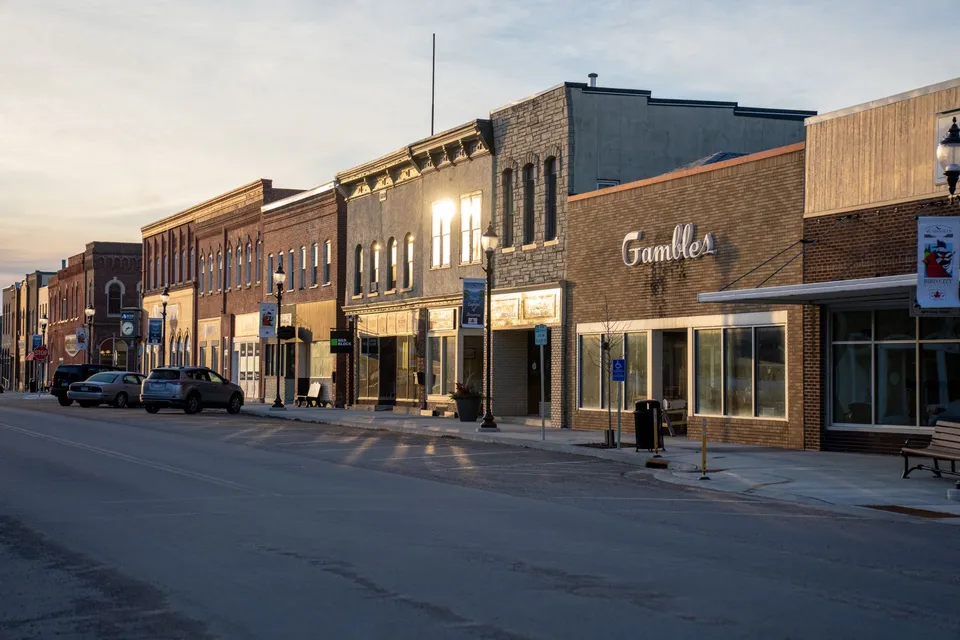
In Virginia, Minnesota, the smartest map for a job seeker is not a county atlas. It is the one that connects a clinic on 9th Street North, a campus in Virginia and another in Eveleth, a transit system headquartered in Gilbert, and school districts that stretch across more than one city. That network tells you where people can work, train, ride, and get their kids through the day. Virginia’s own economic development materials describe the city as a regional hub for commerce, healthcare, education, and retail, which is a clue that the labor market is built from institutions rather than one dominant plant or one downtown strip.
Transit is part of the labor market
Arrowhead Transit is not just a convenience; it is part of how the local workforce functions. The agency says it was founded in 1974, serves more than 500,000 riders annually, operates 120 vehicles, and covers 10 counties across northeastern Minnesota. In North St. Louis County, it provides dial-a-ride in Virginia and Mountain Iron, scheduled service in Eveleth, Gilbert, Aurora, Cook, Hibbing, and other communities, and bus transportation from Virginia to Duluth. That is a real commuting system with actual limits, not a vague promise that someone can figure out later.
The practical lesson is simple: shift design matters. A person taking a clinic, retail, or public-service job in Virginia may be able to get there, but only if the hours line up with weekday service, dial-a-ride windows, or the right route. Arrowhead Transit’s Virginia and Mountain Iron service, plus the Virginia–Eveleth–Gilbert bus schedule, makes the commute part of the job decision, not an afterthought. Employers who understand that tend to write better schedules; applicants who understand it tend to make better choices.
Training splits the market in two
Minnesota North College gives the region two different on-ramps into work. The Virginia campus says its program areas include health, education, and business operations, which lines up with offices, schools, clinics, and other support work. The Eveleth campus is described as the technical side of the Mesabi Range operation, with programs such as graphic design, welding, and construction. In other words, the college is not one generic pipeline; it is a set of local pathways that lead to different kinds of employers and different kinds of day-to-day work.
That difference matters for applicants and employers alike. Someone who wants shop work, fabrication, or hands-on technical training should look differently at Eveleth than at Virginia, while someone aiming for medical support, business office work, or education support will likely find the Virginia campus more directly aligned. The college also notes that Mesabi Range Virginia offers student housing, while Eveleth students may live nearby in Virginia. For a newcomer, that makes the college part of the housing strategy as well as the training strategy.
Schools shape who can actually take the job
The school map reaches farther than the city limits. Rock Ridge Public Schools combines Virginia, Eveleth, and Gilbert into one district, while Mesabi East ties together Aurora, Hoyt Lakes, and Biwabik. Those boundaries are more than an education detail. They affect bus routes, childcare pickup, after-school timing, special education placement, and which household can realistically cover an early shift or a late one. A job offer that looks fine on paper can become hard to manage if the school day and workday fight each other.
Mesabi East adds another useful clue for working families: it serves roughly 8,000 residents across its communities and offers community education and adult basic education. That means the region is not only educating children; it is also helping adults stay in or re-enter the labor force. For a parent returning to work, a student building credentials, or a household balancing two schedules, that kind of support can be just as important as the job posting itself.
Health care and event work fill out the local employer mix
Virginia’s medical-facility page lists Essentia Health-Virginia and Laurentian Medical Clinic in Virginia, while Mountain Iron hosts Fairview Mesaba Clinic. Those addresses point to more than doctors and nurses. They imply jobs in reception, scheduling, billing, environmental services, patient transport, and other support roles that keep a clinic functioning every day. This is one reason Virginia’s economy reads like a services hub rather than a single-industry town.
The Iron Trail Motors Event Center adds a different kind of work. The venue says it has two modern ice arenas with nearly year-round ice availability and can host corporate events, trade shows, conferences, concerts, and weddings. That means the building supports ice operations, maintenance, guest services, concessions, setup, cleaning, and scheduling, not just youth sports. For a job seeker, that widens the list of possible employers; for an employer, it shows how much the local labor pool already moves between service, operations, and event-based work.
The geography is smaller than the labor market
Virginia’s population estimates show a city that is steady but not booming: 8,267 in the July 1, 2024 estimate and 8,187 in the July 1, 2025 estimate, after the 2020 Census counted 8,421 residents. St. Louis County is much larger, with 200,231 people in the 2020 Census, 90,551 households, and 104,926 housing units in the 2024 ACS profile. That gap matters because people here often live in one municipality, train in another, work in a third, and rely on services across the whole core of the Iron Range.
That is also why local recreation and mobility projects matter to work life. The Silver Lake Trail reconstruction is meant to support safe multimodal transportation between schools, parks, recreation facilities, and downtown Virginia, and the city’s eastern recreation area planning shows that access and redevelopment still shape how people move through town. These projects are not hiring announcements, but they do affect whether walking, biking, or short trips can realistically connect home, work, school, and errands.
The clearest takeaway is that a Virginia-area job is rarely just a job. It sits inside a system of transit, schools, clinics, training, and public spaces that reaches through Virginia, Eveleth, Mountain Iron, and Gilbert, then out toward Biwabik, Aurora, Hoyt Lakes, Tower, and Babbitt when the day requires it. If you are comparing openings, start by asking whether the commute, school schedule, and household routine actually fit together. A good next step is to review current local roles at virginiamnjobs.com/jobs/ and match them against the real map of your day.